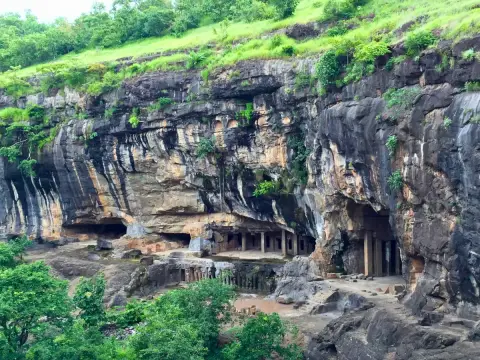
Maharashtra is India’s cave country. About 1,000 of India’s roughly 1,200 rock-cut caves are here. Monks, merchants and kings spent more than a thousand years cutting halls, shrines and monasteries into the Deccan basalt, from the 3rd century BCE to about the 11th century CE. Ajanta, Ellora and Elephanta are world famous. Hundreds more sit quietly on hillsides, a short walk from a village road.
This page lists every major cave site in the state, region by region. Where I have written a full guide or list, the name links to it.
Start here: my cave guides
- Caves near Pune: 11 sites, from Pataleshwar in the city to Karla, Bhaja and Bedse.
- Junnar caves: more than 200 caves on four hills around one town.
- Caves in Mumbai: Kanheri, Elephanta and four more inside the city.
- Cave treks in Maharashtra: 8 treks to caves, from easy walks to a rope climb.
- Pitalkhora Caves: one of the oldest groups in India, near Chhatrapati Sambhajinagar.
Three faiths, one rock
- Buddhist caves are the oldest and most numerous, about two-thirds of the total. Look for the prayer hall (chaitya) with its stupa, and the monastery (vihara) with small cells around a hall.
- Hindu cave temples came later, from about the 5th century. Elephanta, Jogeshwari and Kailasa at Ellora are the great ones.
- Jain caves are fewer and often quieter: at Ellora, Ankai, Mangi-Tungi and around Nashik.
The official count from Maharashtra Tourism’s cave map: 49 key sites, of which 27 are Buddhist, 15 Hindu and 7 Jain.
Konkan: Mumbai, Thane, Raigad, Ratnagiri, Palghar
Mumbai alone has nearly 130 rock-cut caves. Further south, small Buddhist monasteries hide in the Raigad hills along old routes from the coast.
| Site | District | Faith | Why go |
|---|---|---|---|
| Kanheri | Mumbai Suburban | Buddhist | 109 caves inside Sanjay Gandhi National Park |
| Elephanta | Raigad (Mumbai harbour) | Hindu | UNESCO site; ferry from the Gateway of India |
| Mahakali | Mumbai Suburban | Buddhist | 19 caves in Andheri East |
| Jogeshwari | Mumbai Suburban | Hindu | One of the largest Hindu cave temples, still in worship |
| Mandapeshwar | Mumbai Suburban | Hindu | Shiva panels; later a Portuguese church |
| Magathane | Mumbai Suburban | Buddhist | Eroded; for history lovers only |
| Naneghat | Thane | Satavahana | Queen Naganika’s inscription at the top of an ancient pass |
| Kondana | Raigad | Buddhist | Easy walk from Karjat; monsoon waterfall |
| Thanale | Raigad | Buddhist | 23 caves on a forest trek |
| Nenavali (Khadsamble) | Raigad | Buddhist | 37 caves near Pali |
| Kuda | Raigad | Buddhist | 15 caves near Murud, about 30 donor inscriptions |
| Gandharpale | Raigad | Buddhist | 30 caves on the Mumbai–Goa highway near Mahad |
| Chaul | Raigad | Buddhist | On the official cave map |
| Pale | Raigad | Hindu | On the official cave map |
| Panhale Kaji | Ratnagiri | Buddhist and Hindu | 29 caves near Dapoli |
| Lonad | Thane | Being checked | Being checked |
| Bahrot | Palghar | Buddhist | Near Dahanu |
| Polu Sonala | Palghar | Hindu | Protected national monument |
Pune division: Pune, Satara, Sangli, Kolhapur
The heart of early Buddhist cave country, on the routes between the Konkan ports and the Deccan.
| Site | District | Faith | Why go |
|---|---|---|---|
| Karla | Pune | Buddhist | One of the finest prayer halls in India |
| Bhaja | Pune | Buddhist | 22 caves and a group of 14 stupas |
| Bedse | Pune | Buddhist | Quiet; a short climb near Kamshet |
| Ghorawadi (Shelarwadi) | Pune | Buddhist | Prayer hall now a Shiva temple; a natural lava cave nearby |
| Bhandara Dongar | Pune | Buddhist | On Sant Tukaram’s hill |
| Bhamchandra | Pune | Hindu | Where Sant Tukaram meditated |
| Pataleshwar | Pune city | Hindu | 8th-century rock-cut temple on JM Road |
| Lenyadri | Pune (Junnar) | Buddhist | Ashtavinayak Ganesh in Cave 7 |
| Shivneri caves | Pune (Junnar) | Buddhist | On the fort hill; see the Shivneri Fort guide |
| Tulja Lena | Pune (Junnar) | Buddhist | A round prayer hall, c. 50 BCE |
| Manmodi | Pune (Junnar) | Buddhist | Inscription dated 124 CE |
| Dhak Bahiri | Pune / Raigad border | Hindu | Technical climb; ropes and a guide |
| Pale Jain cave | Pune | Jain | 2nd-century BCE inscription |
| Ambivale | Pune | Buddhist | On the official cave map |
| Karad (Agashiv) | Satara | Buddhist | 66 caves in three groups |
| Patan (Yerphal) | Satara | Buddhist | 11 caves in four places |
| Wai caves | Satara | Buddhist | Lohare, Pandavgad and the newly found Renusevasti |
| Shirwal | Satara | Buddhist | Being checked |
| Pateshwar | Satara | Hindu | On the official cave map |
| Kundal | Sangli | Buddhist and Jain | On the official cave map |
| Pohale | Kolhapur | Buddhist | Protected national monument |
Nashik division: Nashik, Ahilyanagar, Jalgaon, Dhule
Nashik has the great Buddhist group at Pandavleni and the state’s richest spread of Jain caves.
| Site | District | Faith | Why go |
|---|---|---|---|
| Pandavleni (Trirashmi) | Nashik | Buddhist | 24 caves with Satavahana inscriptions |
| Ankai-Tankai | Nashik | Jain | Caves on two levels below twin forts near Manmad |
| Mangi-Tungi | Nashik | Jain | A twin-pinnacled hill |
| Chambhar Lena | Nashik | Jain | Near Mhasrul |
| Tringalwadi | Nashik | Jain | Near Igatpuri |
| Patnadevi | Jalgaon | Jain | Near Chalisgaon |
| Bhamer | Dhule | Jain | Being checked |
| Harishchandragad | Ahilyanagar | Hindu | The Kedareshwar cave, a Shiva linga in cold water |
Chhatrapati Sambhajinagar division (Marathwada)
Home to Ajanta and Ellora, and a long list of caves most visitors never hear of.
| Site | District | Faith | Why go |
|---|---|---|---|
| Ajanta | Chhatrapati Sambhajinagar | Buddhist | UNESCO site; 30 caves, 2nd century BCE to c. 480 CE |
| Ellora | Chhatrapati Sambhajinagar | Buddhist, Hindu, Jain | UNESCO site; 34 caves, including Kailasa (Cave 16) |
| Pitalkhora | Chhatrapati Sambhajinagar | Buddhist | 14 caves from the 3rd–2nd century BCE |
| Chhatrapati Sambhajinagar caves (Aurangabad caves) | Chhatrapati Sambhajinagar | Buddhist | 12 caves on the university campus |
| Ghatotkacha | Chhatrapati Sambhajinagar | Buddhist | Steep steps west of Ajanta |
| Daulatabad | Chhatrapati Sambhajinagar | Buddhist | See the Daulatabad Fort guide |
| Rudreshwar | Chhatrapati Sambhajinagar | Hindu | Being checked |
| Paithan | Chhatrapati Sambhajinagar | Hindu | On the official cave map |
| Bhokardan | Jalna | Hindu | Late 8th century, by style |
| Shivleni (Jogai Mandap) | Beed | Hindu | 11th century, near the Yogeshwari temple at Ambajogai |
| Dharashiv caves | Dharashiv | Buddhist, later Jain | 7 caves, state protected |
| Ter | Dharashiv | Hindu | On the official cave map |
| Kharosa | Latur | Hindu and Jain | 12 caves in a laterite hill |
| Mahur (Pandav Lena) | Nanded | Hindu | Near the Renuka Devi temple |
Vidarbha: Amravati and Nagpur divisions
Few caves, far apart, and almost no visitors.
| Site | District | Faith | Why go |
|---|---|---|---|
| Vijasan (Bhadravati) | Chandrapur | Buddhist | Vakataka cave, c. 500 CE; a 22-m passage to a Buddha image |
| Bhatala | Chandrapur | Being checked | Two 5th-century caves found by a Nagpur University team |
| Mansar | Nagpur | Buddhist | On the official cave map |
| Mandhal | Nagpur | Buddhist | On the official cave map |
| Lonar | Buldhana | Hindu | On the official cave map, in the crater-lake town |
| Patur | Akola | Hindu | On the official cave map |
Before you go
- Most big sites are run by the ASI. Expect a small ticket, and check opening days: some caves, such as Kanheri and Elephanta, close on Mondays.
- Start early. Most caves face a climb of steps or a hill path, and the rock holds the heat by afternoon.
- Hire a guide or read up at the big sites. The inscriptions and carvings are the story.
- Never touch, chalk or write on the walls. Two thousand years of history, one careless hand.
- Monsoon caves are beautiful but slippery. On the trek caves, go with someone who knows the route.
I am adding guides to more of these caves as I visit. Until then, where a detail is not confirmed, I say “Being checked” rather than guess.