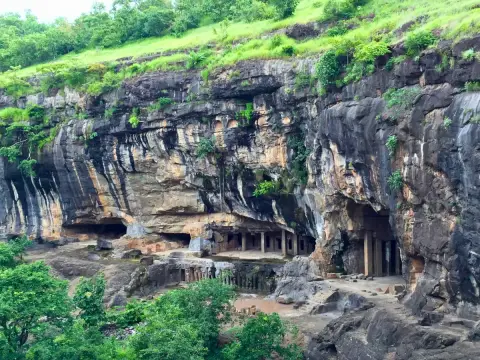
Ajanta is where Indian painting survives from 1,500 years ago. Thirty caves are cut into a horseshoe-shaped cliff above the Waghur river, and inside some of them the walls are still covered in murals: princes and dancers, elephants and boats, and the Buddha’s past lives told scene by scene. Caves 1, 2, 16 and 17 hold the largest group of ancient Indian wall paintings that has come down to us. It is a UNESCO World Heritage Site, and it deserves the hype.
Before you go: the three things that trip people up
- Ajanta is closed every Monday. Ellora closes on Tuesdays. Get this wrong and you drive three hours to a locked gate.
- You cannot drive to the caves. Everyone parks at the Fardapur T-point and takes the shuttle bus for the last 4 km.
- Arrive early. The painted caves are small and dim. Before the tour buses arrive, you can stand in Cave 1 with a handful of people instead of a crowd.
A short history
The caves were cut in two bursts, centuries apart.
The first caves, from about the 2nd century BCE. Caves 9, 10, 12, 13 and 15A are the oldest. Caves 9 and 10 are prayer halls built around a stupa. Their faded murals tell Jataka stories, the tales of the Buddha’s earlier lives.
The great burst, about 460 to 480 CE. Under the Vakataka emperor Harishena, Ajanta came alive again. Most of the caves you see were cut in these few decades, many at the same time, paid for by the ruling elite: Harishena himself is linked with Cave 1, his minister Varahadeva gave Cave 16, and Upendragupta, a regional king under the Vakatakas, paid for Caves 17 to 20. When Harishena died, around 477 CE, the work slowed, and by about 480 CE the patrons had left. Some caves were never finished.
Lost and found. Chinese Buddhist travellers wrote about Ajanta, but over the centuries the jungle closed over it. On 28 April 1819, a British cavalry officer named John Smith, out hunting tigers, was led to Cave 10 by a local boy. He scratched his name and the date on a pillar. You can still see it.
Which caves to see
The caves are numbered 1 to 30 along the cliff from one end to the other, not in the order they were made. A path runs along the face, with steps between levels.
| Cave | Why stop |
|---|---|
| 1 | The finest paintings at Ajanta, including the Bodhisattvas Padmapani and Vajrapani beside the shrine door. Linked with Harishena. |
| 2 | More paintings, with scenes of the noble women in the Buddha’s life. |
| 9 and 10 | The oldest prayer halls. Cave 10 has John Smith’s 1819 inscription. |
| 16 | A monastery given by the minister Varahadeva, with his inscription and murals. |
| 17 | One of the four great painted caves, paid for by Upendragupta. |
| 19 | A 5th-century prayer hall, one of the finest carved halls of the late phase. |
| 26 | The big late prayer hall, with the huge reclining Buddha. |
If you are short on time, see Caves 1 and 2 first, while your eyes are fresh, then walk along the crescent to 16, 17, 19 and finish at 26.
Timings and tickets
- Open: about 9 am to 5 pm, Tuesday to Sunday. Some reports give 5:30 pm, so go early rather than late.
- Closed: every Monday.
- Tickets (as last reported): ₹40 for Indian, SAARC and BIMSTEC visitors (₹35 online or by card), ₹600 for foreign visitors (₹550 online), free for children under 15.
- Shuttle bus: a separate small fare each way from the T-point, last reported at ₹25 non-AC and ₹30 AC.
- Managed by: the Archaeological Survey of India (ASI).
How to reach Ajanta
- From Chhatrapati Sambhajinagar: about 100 km, 2.5 to 3 hours by road on the Jalgaon road to Fardapur. This is the usual base, and the closest airport.
- By train: the nearest railway station is Jalgaon, about 60 km away. Handy if you are heading north or east afterwards.
- From Mumbai: about 430 km. Most people come via Chhatrapati Sambhajinagar and stay two nights to see both Ajanta and Ellora.
- The last 4 km: park at the Fardapur T-point and take the shuttle bus to the caves.
Ajanta and Ellora: how to plan both
The two are about 100 km apart and close on different days. The simple plan, from a base in Chhatrapati Sambhajinagar:
- Day 1 (not a Tuesday): Ellora, plus Daulatabad Fort on the way.
- Day 2 (not a Monday): Ajanta. Leave early. Afterwards, drive back, or carry on to Jalgaon for an evening train.
Got another half-day? Pitalkhora, one of the oldest cave groups in India, is in the same district and almost empty.
Tips for the visit
- Keep your camera flash off. The paintings have lasted 1,500 years; light and touch are what damage them.
- Carry water and wear comfortable shoes. The visit means steps and a long walk along the cliff.
- Hire a guide or read up first. The murals are full of stories, and you will see far more if someone tells you what to look for.
- Do not touch the walls, even in the unpainted caves.
More caves around the state: Caves of Maharashtra, the complete list.