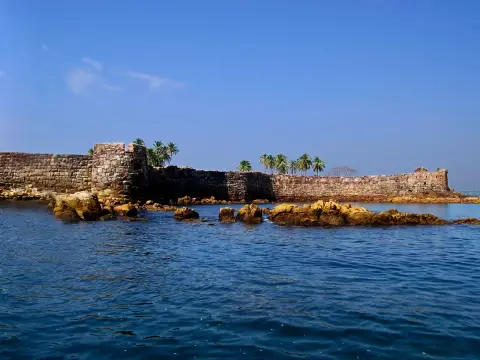
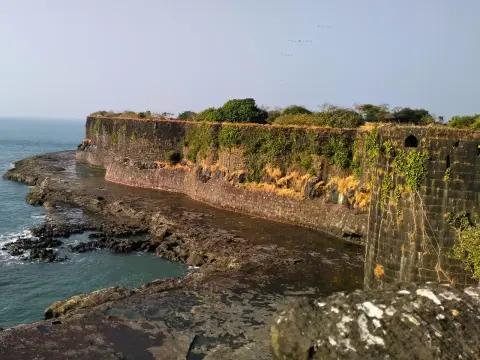
Janjira is the sea fort I’d take a friend to first: you cross on a sailboat, the walls rise straight out of the water, and you’re standing in the one fort on this coast that the Marathas never took. It’s an easy visit from Murud, but boats only run outside the monsoon, so plan around that.
Why Janjira matters
The name comes from the Arabic jazeera, island. Tradition says the island first had a wooden fort built by the Koli fishermen of Rajapuri, led by their headman, to keep off pirates. In the late 1400s it was taken for the Nizam Shahi sultans, whose capital was Ahilyanagar (then Ahmednagar), and its defences were rebuilt in stone over the next century. The stone fort is usually credited to Malik Ambar, the Abyssinian-born regent of the Nizam Shahi state, though the dates in popular accounts are muddled. From the 1600s it was the stronghold of the Siddis, a community of East African (Abyssinian) origin who became a sea power on the Konkan coast and later ruled as the Nawabs of Janjira.
Chhatrapati Shivaji Maharaj tried to take Janjira more than once and failed. In 1682 Chhatrapati Sambhaji Maharaj attacked it. Maratha accounts tell of Kondaji Farzand, who went into Janjira pretending to have defected, planning to blow up its gunpowder; the plot was betrayed and he was killed. The siege was then lifted when a Mughal army advanced on Raigad. Janjira stayed with the Siddis until the state joined India in 1948.
The boat from Rajapuri
Boats leave from Rajapuri jetty, a short way from Murud town. The sailboats run across the mouth of the Rajapuri creek and stop at the stone steps of the main gate, which the sea washes over. The crossing takes under 30 minutes. Boats run from morning to evening, and many boatmen allow about 45 minutes on the island before the same boat brings you back. Fares, exact timings and the time allowed change; ask at the jetty before you board. Local guides wait at the gate. Hiring one is worth it if you only have 45 minutes: they know the route round the main sights, and a little bargaining is normal.
What to see on Janjira
- The main gate. It faces the shore but is hidden by the walls until you’re only about 12 m away, which is how it was meant to work.
- The bastions and cannons. The fort has about 22 bastions, with cannons still on many of them. Three big guns near the gate have names: Kalal Bangadi, Chavri and Landa Kasam.
- The sixteen-sided lake in the north of the fort, which held the garrison’s fresh water, with a second lake nearby.
- Surulkhan’s palace: the ruined three-storey mansion of a Siddi ruler in the middle of the fort. Its top gives a view right round the island.
- The carved beast at the gate: a tiger-like animal gripping elephants in its claws and tail, read as a show of Siddi power.
- The Darya Darwaja, a small sea gate on the west side for escape by water.
- A Persian inscription near the gate.
Padmadurg (Kasa fort)
From the ramparts you can see a smaller fort on a rock in the sea, a few kilometres away. This is Padmadurg, also called Kasa fort, built by the Marathas in the late 1600s to watch and challenge Janjira; sources differ on the exact year. It has six bastions, and during clean-up work in 2011 archaeologists found around 250 old cannonballs there. Visits to Padmadurg need a separate boat and aren’t always allowed. Being checked.
How to reach Murud
- From Mumbai: about 150 km by road via Panvel, Pen, Alibag and Kashid to Murud, or by ferry to the Alibag side and then by road. Alibag is about 54 km from Murud, Kashid about 22 km.
- From Pune: down the ghats towards Roha, then on to Murud.
- By train: Roha on the Konkan Railway is the nearest station, about 40 km away.
- By bus: ST buses run to Murud from Mumbai, Pune and Alibag.
- To the jetty: Rajapuri is about 5 km from Murud, a short drive or rickshaw ride.
My tips
- Go early, so you get the most time on the island before the last boat.
- Wear shoes with grip. The gate steps are wet from the sea.
- Carry water and a cap. There’s little shade on the ramparts.
- Don’t plan Janjira from June to August. There are no boats.
- Stay in Murud and make a day of the coast. A homestay gets you Konkan home cooking.
- End at Murud beach for the sunset, an easy hour after the fort.
After the fort
- The Nawab’s palace in Murud, the later seat of the Nawabs of Janjira, seen from outside; it is private.
- Murud beach, right in town.
- The Siddi tombs at Khokri, about 2 km from Murud.
- Ghosalgad, a hill fort towards Roha that served as an outpost of Janjira’s rulers.
Places near Janjira
- Khanderi Fort, another island fort on the Raigad coast.
- Raigad Fort, Chhatrapati Shivaji Maharaj’s capital, inland from the same district.