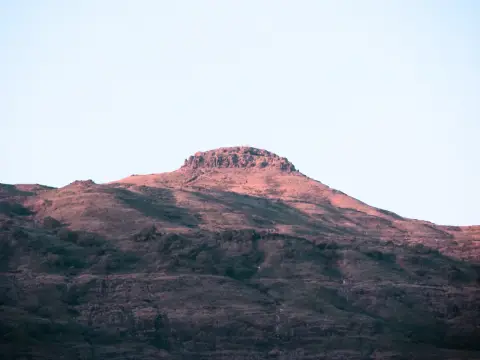
Mangi Tungi is two rock pinnacles joined by a long stone stairway, with Jain caves near both summits and a 108 ft statue of Rishabhdev carved into the hillside below. It isn’t a technical trek: it’s a long, steady climb on good steps. Go if you want a big view of the Baglan hills and a quiet, very old pilgrimage site. Skip it if your knees hate stairs, because there are thousands of them.
Why Mangi Tungi matters
For Digambar Jains this is a Siddha Kshetra, a place where souls are believed to have reached liberation. Jain tradition holds that Ram, Hanuman, Sugriva and many monks attained moksha here, and the hill is also linked with Balram, Krishna’s elder brother. Pilgrims have climbed it for centuries: images in the caves have inscriptions, and one in the Adinath cave dates to 1343 CE.
The newest addition is the Statue of Ahimsa, a 108 ft figure of Rishabhdev (Rishabhanatha), the first Tirthankara, carved out of the hill and consecrated in February 2016. Guinness World Records lists it as the tallest Jain idol in the world. The idea came from the Jain nun Gyanmati Mataji in 1996.
How the climb goes
- Bhilwadi to the foot of the steps. From the village it’s a short walk along the road to where the stairway begins. If you’ve driven, you can park closer.
- The long stairway (about 2 hours). Stone steps zigzag up the face of the hill. About halfway, two rock-cut caves on the left hold Jain images. The steps end at a stone archway on the plateau between the two peaks.
- Mangi, to the left. The western peak, about 1,324 m. Its caves hold many old Jain images.
- Tungi, to the right. The eastern peak, about 1,331 m, the slightly higher one. About 30 minutes from the archway, with a marble Krishna temple along the way and two caves near the top.
A built path links the two peaks across the plateau, so you can do both in one visit. Allow 4 to 6 hours from Bhilwadi and back for both.
What to see
- The cave shrines on both peaks: rock-cut caves with seated and standing Jain images, many of them centuries old. Mangi has about ten caves; Tungi has two.
- The archway and plateau between the peaks, where the whole climb opens up.
- The view west from Mangi to Tambolya hill and, on a clear day, the Baglan forts: Salher, Salota, Mulher and Hargad.
- The Statue of Ahimsa at Rishabhgiri, best seen in the soft morning light.
- The temples at the base in Bhilwadi, including Adinath and Parshvanath temples.
How to reach Bhilwadi
- From Nashik: about 125 km via Satana and Taharabad, roughly 3 hours by road. ST buses run from Nashik to Satana and Taharabad, and on from Taharabad to Bhilwadi.
- From Mumbai: about 290 km via Nashik, 6 to 7 hours.
- From Pune: about 330 km via Nashik.
- By train: Nashik Road and Manmad are the nearest big stations; go on by bus or cab.
My tips
- Start early. Pilgrims set off before dawn, and the steps get hot by late morning.
- Carry 2 litres of water each. There’s none on the route.
- Respect the shrine rules. This is a place of worship: dress modestly, keep quiet in the caves, and follow the signs about footwear and leather items.
- In the monsoon, take it slow. The steps are slippery and the plateau can be windy and foggy.
- Pair it with a Baglan fort. Salher, the highest fort in Maharashtra, is about an hour’s drive away.
Places near Mangi Tungi
- Salher Fort, the highest fort in Maharashtra and a UNESCO World Heritage site, in the same Baglan hills.
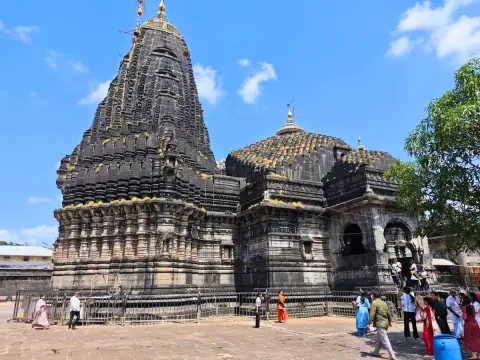
- Trimbakeshwar Temple, on the way back through Nashik.
- Caves of Maharashtra, for more rock-cut Jain, Buddhist and Hindu caves.